Indianapolis 500 champions, legendary drag racer and sprint car legends among inductees
BAKERSFIELD, California (June 9, 2026) – Indianapolis 500 champions, a legendary Funny Car drag racer, race engine innovators and builders and a pair of sprint car legends comprise the West Coast Stock Car/Motorsports Hall of Fame’s 2026 Pioneers of Speed.
The 2026 Pioneers of Speed are:
- Clint Brawner, Phoenix, Arizona, 1969 Indianapolis 500-winning crew chief with Mario Andretti and multiple American Automobile Association(AAA)/United States Auto Club (USAC) titles
- Jimmy Bryan, Phoenix, Arizona, 1958 Indianapolis 500 winner and three-time AAA/USCAC championship car champion
- Al Dean, Long Beach, California, his Clint Brawner-wrenched Dean Van Lines Specials won five AAA/USAC titles with Bryan and Andretti
- Bill Deschamps, Lakeport, California, one of the founding fathers of the Northern California Racing Association (NARC) and winner at more than 55 West Coast tracks
- Jim Dunn, La Mirada, California, a fixture in drag racing for more than 70 years, campaigning some of iconic Funny Cars in history while winning the most significant races
- Vic Edelbrock Sr., Beverly Hills, California, hot rod and midget speed equipment innovator and manufacturer
- Joe and Walt James, Los Angeles, California. Joe was the 1952 AAA Midwest Sprint Car champion and two-time Indianapolis 500 qualifier. Walt, an auto recycler, became president of the California Roadster Association in 1951 and guided it in transition to the California Racing Association, a premier West Coast sprint car sanctioning body
- The Morales Brothers, Anaheim, California. Led by National Sprint Car Hall of Famer Alex, the nine Morales brothers owned the famed Tamale Wagon sprint car and Indianapolis car. The team hired some of motorsports’ most famous stars – including AJ Foyt and Parnelli Jones
- Ed Pink, Los Angeles, California, Ed Pink Racing Engines (EPRE) quickly became known for its work with the 426 Hemi in Top Fuel, as well as cylinder head and ignition work and the Buick V-6 program for IndyCar racing
- George and Harold (Hal) Robson, Huntington Park, California. George was born in England and was the winner of the 1946 Indianapolis 500, the first running following the war. He was killed the same year in a AAA race at Atlanta, Georgia. Hal, a Canadian by birth, began racing sprint cars in the pre-War era in Southern California, winning 50 features at a variety of tracks. He competed in three Indianapolis 500s.
Complete biographical information for each inductee can be found at www.westcoaststockcarhalloffame.com
“This year’s Pioneers of Speed inductees represent the true picture of the greats that played such an important role in growing the sport of motor racing during the first 75 years of our great racing industry we all love,” said Ken Clapp, Chairman and CEO of the West Coast Stock Car/Motorsports Hall of Fame. “Just wish I had known all of them personally. It truly would have been an honor.”
The 2026 West Coast Stock Car/Motorsports class of inductees has been chosen and will be announced during the June 26-28 NASCAR Cup, O’Reilly Auto Parts and ARCA Menards Series West weekend at Sonoma Raceway. The Hall’s 2026 Heritage class of Chris Evans, David Fuge, Jim Michaelian, Johnand David Philpott, Chris Pook and the Stockman family were previously announced.
Inductions will be held on October 1 at the South Point Hotel Casino & Spa in Las Vegas, Nevada. The sixth Kickin’ Doorz Down Philanthropist of the Year by 51FIFTY will be announced during the festivities.
The West Coast Stock Car/Motorsports Hall of Fame gala, presented by Wide World Technology Raceway at Gateway, kicks off a weekend of speed at the Las Vegas Motor Speedway. NASCAR ARCA Menards Series West racing takes place at The Bullring short track on October 2, followed by the O’Reilly Auto Parts Series (October 3) and NASCAR Cup Series (Oct. 4) on the 1.5-mile track.
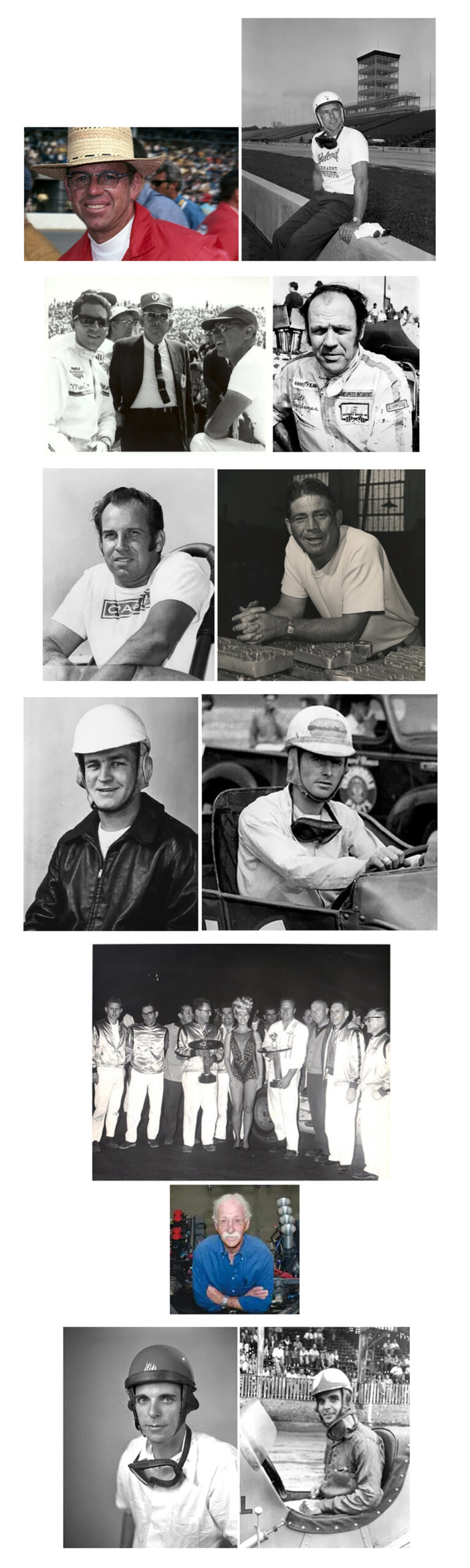
Images – (top to bottom, left to right) Clint Brawner, Jimmy Bryan (IMS photo), Al Dean (IMS photo), Bill Deschamps (Dennis Mattish photo), Jim Dunn, Vic Edelbrock, Joe James and Walt James (IMS photos), The Morales brothers with AJ Foyt, Ed Pink, and George and Hal Robson (IMS photos)
Pioneers of Speed 2026
Clint Brawner
Clint Brawner was born on December 15, 1916, and survived 71 years before taken by cancer. Brawner’s life was focused on racing, especially Indy cars.
He contributed enormously to the success of the many race car drivers who steered the cars he prepared, among them Jimmy Bryan, Bobby Ball, Troy Ruttman, Bill Vukovich, Bob Sweikert, Eddie Sachs, Chuck Hulse, Art Pollard, A.J. Foyt, Roger McCluskey, Jimmy Caruthers and Mario Andretti (for whom he was crew chief at the 1969 Indianapolis 500 during Andretti’s only win in the 500-mile race).
As a kid, Brawner worked on the mechanical things that were uniquely necessary for life in Phoenix, Arizona. A self-taught mechanical genius, he could do it all- build cars, build engines, set cars up and advise the drivers.
Brawner’s philosophy of “man made it, man can fix it” was appropriate to him alone. His skill, work ethic and focus led to 51 Indy car victories and four poles in the Indianapolis 500. Brawner is an inductee into the Motorsports Hall of Fame of America.
Jimmy Bryan
In Jimmy Bryan, American racing had a champion who looked like a champion should – big, brawny and broad-shouldered, good-natured but tough to the bone, with a cigar between his teeth and his foot flat on the floor.
Nicknamed the “Arizona Cowboy,” Phoenix native Bryan was a master of the dirt ovals that dominated the Big Car circuit during the 1950s, and on them in the middle of the decade he won three American Automobile Association national championships.
Born January 28, 1926, he began racing track roadsters before switching to midgets in 1947. Between Oct. 25, 1953, and Veterans Day 1957, he won 17 of 34 races run on the dirt.
Bryan won the 1958 Indianapolis 500 and finished in the top three in his nine 500 starts. He also won the 1957 Race of Two Worlds at Monza, Italy.
Bryan died June 19, 1960, following an accident at Langhorne, Pennsylvania. Bryan is an inductee into the Motorsports Hall of Fame of America.
Al Dean
Al Dean, born in Long Beach, California, was by far the most successful American Automobile Association/United States Auto Club championship car owner of the 1950s and 1960s.
A self-made transit company magnate, Dean also was renowned for having given Indianapolis 500 rookie tests to both Mario Andretti and A.J. Foyt. His first win came in the inaugural Hoosier Hundred of 1953, with Bob Sweikert.
His Clint Brawner-wrenched Dean Van Lines Specials won an amazing 38 National Championship races from 1953 through 1967 in the hands of Jimmy Bryan and Mario Andretti (17 each), Eddie Sachs (three), and Bob Sweikert (one).
Bryan won the national title in 1954, 1956, and 1957, and was runner-up in 1955. He also won the non-points Monza (Italy) 500 in 1957.
Andretti won the National Championship title in 1965 and 1966 and was runner-up in 1967. Dean was never able to win the Indianapolis 500 with his race team, but he did have five top three finishes and four Indianapolis 500 poles. He died at age 61. He is an inductee into the Indianapolis Motor Speedway Hall of Fame.
Bill Deschamps
Bill Deschamps of Lakeport, California began his racing career in 1956, driving a hardtop at Lakeport Speedway when it still was a dirt track. “Billy D” was one of the founding fathers of the Northern California Racing Association (NARC) and played a major role in getting the Lakeport facility paved.
Deschamps’ career saw him drive hardtops, jalopies and supermodifieds for various owners throughout the years the years. He later owned and drove a sprint car on the NARC circuit, his No. 44 car claiming victories at more than 55 tracks on the West Coast, including Lakeport, Ukiah, Shasta Speedway in Anderson, California, Roseville Raceway and Altamont Speedway. He also raced in Oregon, Washington and Canada, claiming the International Drivers Challenge in 1972. He also was the Golden West Classic champion in 1974. Deschamps passed away at age 72 in 2021.
Jim Dunn
For more than 70 years, Jim Dunn has been a fixture in drag racing, campaigning some of the most iconic Funny Cars in history, winning some of the most significant races, and providing driving opportunities for some of the biggest names in the sport. Dunn, a former Los Angeles County firefighter, has presented himself as a gruff, no-nonsense team owner, but underneath that exterior is the sharp mind, quick wit, and personality of one of the most unique characters in drag racing. He began his love affair with drag racing as a 15-year-old who asked for parts for his birthday to get his race team off the ground. For decades after that, Dunn was at the track innovating and winning. He was the featured subject of the cult classic Funny Car Summer movie, and possibly most significantly, he won the Funny Car title at the 1972 World Finals in the first and only rear-engined Funny Car. Dunn competed in the 1958 NASCAR Cup Series race at Riverside International Raceway.
Vic Edelbrock
Born in Kansas in 1913, Vic Edelbrock Sr. grew up in a comfortable manner supported by the family grocery store. The Great Depression left most of Kansas destitute and Vic was soon on his way to California.
In 1933 Edelbrock opened his first shop on Wilshire Boulevard in Beverly Hills. In 1938, Edelbrock bought his first “project car,” a 1932 roadster. This was to be the vehicle and entry into the hot rod road and the dominance of Edelbrock at the dry lakes. Edelbrock went on to design the Slingshot, a manifold that was to revolutionize the flathead engine.
During the war Edelbrock put his mechanical skills to good use helping fabricate aircraft parts. This work also gave him valuable machine experience and led to the invention of more speed equipment, including aluminum racing heads for flatheads.
Post-war Edelbrock was consumed with midget racing. With chief wrench Bobby Meeks, the Edelbrock team soon made a reputation for themselves beating out the Offys with their V8-60s. Edelbrock also started a catalogue to sell speed equipment countrywide.
The mid Forties and Fifties saw some of the most famous hot rods come out of the Edelbrock shop. Edelbrock is a member of multiple halls of fame including the Motorsports Hall of Fame of America. He died in 1962 at age 49.
Joe and Walt James
Joe and Walt James were born in Mississippi and moved to Southern California during the Depression. Both served in World War 2 – Walt in the Army Air Corps and Joe in the Navy. Post-war, the brothers began racing jalopies, roadsters and sprint cars.
From 1949 to 1952, Joe James competed in American Automobile Association “big car” and sprint races, winning in AAA for the first time at Dayton, Ohio with his Bob Estes Offenhauser team. He qualified for his first Indianapolis 500 in 1951 and finished 13thin the 500 the following year.
“Little Joe” captured the 1952 AAA Midwest Sprint Car championship, winning six times. He died at age 27 following a November 2 championship car accident in the Santa Clara Fairgrounds track in San Jose.
Walt James, an auto recycler, became president of the California Roadster Association in 1951 and guided it in transition to the California Racing Association. In the 1950s and 1960s the CRA was one of the premier motorsports sanctioning organizations and it was not uncommon to have nearly one-third of the Indianapolis 500 filled by CRA graduates.
He retired in 1970, built Indian Dunes Motorcycle Park in Castaic, California and formed the Western Racing Association for vintage race cars. James passed away in 2009 at age 86. Both brothers are National Sprint Car Hall of Fame inductees.
Morales Brothers
Alex Morales got involved in racing hot rods as a youth in Southern California in the 1920s. The first Tamale Wagon, named after the specialty of the family’s Mexican food business (Alex Foods), ran at the old Silver Lake Speedway circa 1928. Alex was the oldest of nine brothers – Gil, Chuck, Sammy, Loddie, Bill, Richie, Bob and Louie. In the 1930s and 1940s, Morales raced at the American Legion-promoted tracks at Ascot and Huntington Beach. After World War II he competed in California Roadster Association competition. In 1959, Chuck Hulse piloted the Roger McCluskey-built Tamale Wagon to Morales’ first of six CRA championships, with drivers Bob Hogle, Billy Vukovich, Bobby Olivero and Rick Gowdy. He also ventured out to race with the U.S. Auto Club hiring drivers like Parnelli Jones, A.J. Foyt and Mike Mosely. In 1979 Morales began his association with Duane (Pancho) Carter, and winning the 1981 CART Michigan 500. The following year the team finished third in the Indianapolis 500. Besides Alex, his brothers Gil and Chuck were involved in the Tamale Wagon team. Alex Morales’ son Andy also crewed the family’s sprint car, capturing the 1989 and 1991 CRA titles with Ron Shuman. Alex Morales passed away in 1988 at the age of 80. He is a member of the National Sprint Car Hall of Fame.
Ed Pink
Ed Pink was born in Los Angeles and was exposed to hot rodding in his teenage years. He had legendary mentors, among them Vic Edelbrock Sr., learning from the titans of the high-performance industry. Pink was a veteran of the Korean War and following a stint in the general repair business, he worked at various engineering and race shops learning the engine business. By 1961, he went into engine building full-time and TV Tommy Ivo became an early customer. Ed Pink Racing Engines (EPRE) quickly became known for its work with the 426 Hemi in Top Fuel, as well as cylinder head and ignition work. Among other accomplishments, was the Buick V-6 program for IndyCar racing, enhancing the Cosworth Racing efforts, and stacking up IndyCar wins with many different drivers. By the 1990s, he became the premier builder for the United States Auto Club (USAC) Midget series with eight championships and over 100 national event wins with notable drivers such as Tony Stewart, Kasey Kahne, and J.J. Yeley being powered by EPRE. Pink passed away in 2025 at the age of 94.
George and Hal Robson
George Robson was born in England and with his family moved to Southern California where he began his racing career during the mid-1930s. The older brother of Harold (Hal) Robson, he made his debut at the Championship/IndyCar level during the1938 in a race at the Syracuse Mile in New York. Earlier that year, he had also competed in a non-championship points event held at the Milwaukee Mile. Robson was the winner of the 1946 Indianapolis 500, the first running following the war. Driving for Joel Thorne, Robson took the lead for good on lap 93. He previously had qualified for the 500 in 1940-41 after a relief driving role in 1939. Robson was killed later that year in AAA race at Lakewood Speedway in Atlanta, at age 37.
Harold (Hal) Robson was born in Canada in 1911 but moved with his family to Southern California as a child. He started his driving career in 1930. After three years on the tough roadster circuit, he progressed to sprint cars, racing on the Southern Ascot half-mile for owners named Bruce Bromme, Alex Morales and J.C. Agajanian. He won over 50 features between 1936 and 1939 alone. He went racing in the Midwest with AAA in 1939 with an eye towards Indy. Hal would compete in three 500’s, including the one his brother George won in 1946. He was injured severely in a crash at Salem Speedway in Indiana in 1947 but returned to racing after several months of healing. Robson retired from racing in 1955 and passed away at the age of 84 in 1996. He is a member of the National Sprint Car Hall of Fame.
About the West Coast Stock Car/Motorsports Hall of Fame:
The West Coast Stock Car/Motorsports Hall of Fame was conceived in 2001 as a means of recognizing significant contributors and contributions to the sport of stock car/motorsports competition. The mission of the West Coast Stock Car/Motorsports Hall of Fame is founded to preserve history and heritage of the important role west coast stock car and motorsports figures have played in the sport’s development and continuation and to recognize, through annual enshrinement, of outstanding individuals and groups within the sport such as, but not limited to, designers, engineers, mechanics, drivers, race track owners, promoters, publicists and members of the motorsports media.
The Hall is a 501(c)3, soon to be (c)4 charitable organization, dedicated to supporting a variety of organizations and groups from coast to coast. The Hall has raised more than $1 million during the past seven years for youth, health and safety, hospitals, animal rescue, military and other charitable causes.
For more information on the West Coast Stock Car/Motorsports Hall of Fame visit: www.WestCoastStockCarHallofFame.com
Media Contact:
Owen A. Kearns
okearns@bak.rr.com
661-342-2983